Indian Polity / Making of the Constitution


|
|
|
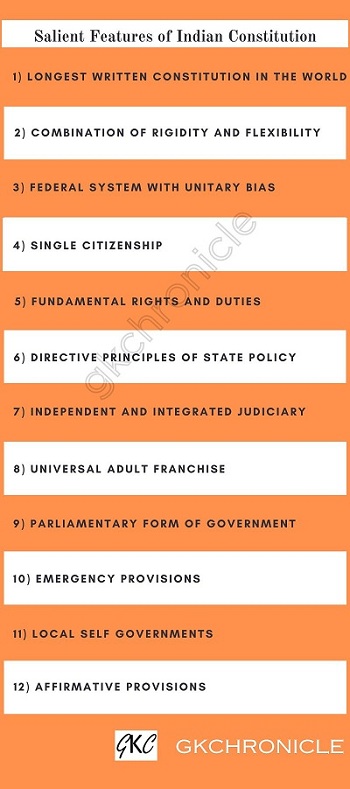
The salient features of our Constitution include the Largest written Constitution in the world, Constitution with combination of rigidity and flexibility, Federal system with unitary bias, Single citizenship for all its citizens, Fundamental rights of the people, Fundamental duties to be performed by the citizens, Directive principles of state policy to be implemented by the State, Independent and integrated judiciary, Parliamentary form of Government, etc.
One of the key features of Indian Constitution is that it is the longest written Constitution in the world. It is longest because the framers of our Constitution examined Constitutions of different countries along with the working of the Government of India Act, 1935 before writing the Constitution and liberally borrowed suitable provisions from them. The other reasons for the bulkiness of Indian Constitution is due to inclusion of Articles on the basis of religion, region, caste, sex, etc., inclusion of administrative aspects like Election Commission, Public Service Commission, etc., exhaustive enumeration of rights and non-rights (Directive Principles of State Policy), inclusion of temporary and transitional provisions like Articles 371A to 371I, etc.
The salient features of Indian Constitution are briefly describe below:
Bulkiness of Indian Constitution is explained in terms of Articles, PARTs and Schedules. On 26th January, 1950, the Constitution contained 395 Articles, 22 PARTs and 8 Schedules. Now, it contains 448 Articles, 25 PARTS and 12 Schedules.
New Articles that are being added, will not be given the number as 396 but should be added like 1A, 1B, 24A, etc. When an Article
gets deleted, it should be kept vacant.
For example, Article 31 was deleted in 1978 in the 44th Amendment ofthe Constitution.
The Article was kept vacant and new Articles to the same number were added as 31A, 31B, etc.
PART is the partition of Articles into different sections. This is made for easy access. Schedule is an explanatory part of an Article. It is an annexure to the Constitution.
Indian Constitution is partially flexible and partially rigid. It is flexible because some of the Articles in the Constitution can be amended
with simple majority in the Parliament, while some other Articles can be amended with a special majority of the Parliament. The flexibility is
one of the unitary features of Indian Constitution because Parliament alone can amend certain Articles.
The Constitution is said to
be rigid because some of the crucial Articles need to be amended by special majority of the Parliament and consent of the states. So,
rigidity is one of the federal features of Indian Constitution.
Though the word Federation is not incorporated into the Indian Constitution, India is a federation of states with maximum power given to
the Central government.
The Constitution of India says it as "Union of States". That means Indian
federation has an undestroyable Union of destroyable states which implies that the states can be merged or divided, but they cannot go away
from the Union.
According to the Constitution of India, all the citizens residing in the 28 States and 8 Union Territories will have a single citizenship in the country. All the citizens enjoy the same citizenship rights irrespective of the State they belong.
Fundamental Rights are included in our
Constitution so that the State cannot exercise arbitrary and absolute power against its citizens. They protect the rights of individuals
against the other individuals and against the Government itself.
The fundamental duties
reminds the citizens about their responsibility towards the State and the fellow citizens.
The Directive Principles of State Policy (DPSP) that are included into the Constitution, are a kind of guidelines to the State in the governance of the country so that it will strive to push for the wellbeing of its people. Based on the nature of the Directive Principles, M.P. Sharma classified DPSPs into three broad categories namely, Socialistic, Gandhian and Liberal Directive Principles.
The Judiciary is the final resort for the citizens of the country to protect their rights. So, its independence is utmost important. The
makers of the Constitution envisaged this and kept the Judiciary completely independent of both Executive and the Legislature. Independence of
Judiciary is one of the basic features of Indian Constitution.
Ours is a an Integrated Judiciary as we have single hierarchy of
Courts and no separate courts for Central as well as State laws.
Indian Constitution guarantees that without any discrimination, every adult above the age of 18 years has the right to exercise his vote to elect the people's representatives. Originally, the age limit of adult suffrage was 21 years but later it was reduced to 18 years through the 61st Constitutional Amendment Act, 1988, which came into force on 28th March, 1989.
Parliamentary form of government is nothing but responsibility of the Executive towards the Legislature, which has the people's
representatives.
Unlike the Presidential form of government, in parliamentary form of government the Executive and Legislature are clubbed together,
making the Executive more accountable towards the Legislature.
Though the term 'Secular' was not there in our original Constitution, it was later added to the Preamble of Indian Constitution by the 42nd Constitutional Amendment Act, 1976. A Secular State is a State that does not uphold any particular religion as its official religion. Being a Secular State, India protects and gives respect to all religions equally.
The Constitution of India follows the doctrine of separation of powers, which means the powers of the 3 organs of the government i.e. Executive, Legislature and Judiciary are kept separate from one another.
Though the Indian Government operates in a federal structure, during the proclamation of emergency, all the powers will be vested with the Union government and the Constitution acquires a kind of unitary character.
In order to enhance the democratic decentralization, Indian Constitution renders power to the rural and urban populace to manage their developmental activities on their own with the assistance of local self governments.
Indian Constitution incorporated some affirmative provisions for the Scheduled Castes (SC) and Scheduled Tribes (ST) in government jobs and made provisions for their upliftment by reserving some seats in Legislatures as well as educational institutions.